Robotics & Automation
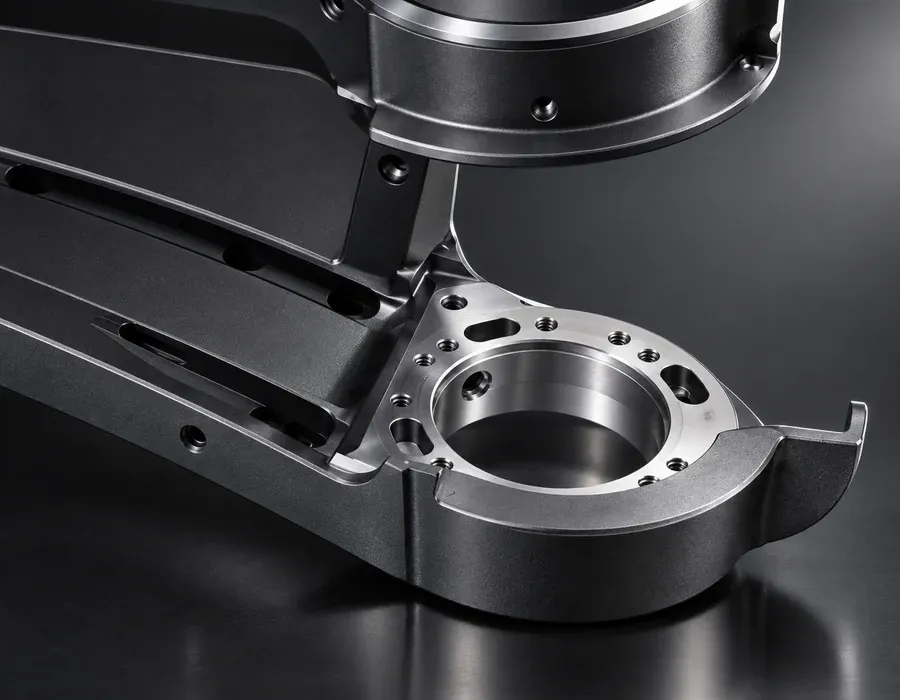
Lightweighted, Repeatable Components for Robotic & Automation Programs
Sourcing and production support for structural links, actuator housings, and end-effector components in aluminum, stainless, and titanium, held to tight tolerance across full production batches.
Industry Context
What robotics & automation buyers deal with
Robotic arm and end-effector components need aggressive lightweighting without sacrificing stiffness, driving non-standard rib and pocket geometry
Actuator and gearbox interfaces (harmonic drive, planetary, linear) demand tight, repeatable tolerances to avoid backlash and vibration across every unit in a batch
Mixed-material programs — aluminum structural links alongside stainless or titanium wear surfaces — complicate single-supplier sourcing
Complex internal passages for pneumatic or hydraulic lines add machining steps general job shops aren't set up for
Design-for-manufacturability feedback is needed early, since automation programs iterate hardware quickly during development
Batch-to-batch repeatability matters more than in one-off industrial parts — a fleet of robots needs interchangeable components
Typical Parts
- Robotic arm structural links and joint housings
- Actuator and gearbox components (harmonic drive housings, planetary carriers)
- End-effector and gripper jaw components
- Sensor, vision, and LiDAR mounting brackets
- Linear motion system components (rails, carriages, mounting blocks)
- Custom automation fixtures and connection interfaces
Common Materials
- Aluminum 6061-T6 / 7075-T6
- Stainless steel (304, 316)
- Titanium Grade 5 (weight-critical structural components)
- Alloy steel for high-load gearbox and drive components
Quality Expectations
- Tolerances to ±0.0005 in. (0.0127 mm) on repeatable production runs
- Dimensional consistency verified across full production batches, not just first article
- Design-for-manufacturability review during early hardware iteration
- Surface treatment documentation (hard coat anodizing, black oxide) for wear and corrosion resistance
- Material certification for structural and load-bearing components
How Oakmet Helps
Oakmet's role in robotics & automation sourcing
- Sourcing 5-axis CNC and CNC Swiss turn-mill partners experienced with lightweighted robotic structural components
- Coordinating batch-to-batch dimensional consistency checks for fleet-scale automation programs
- Providing design-for-manufacturability feedback during early hardware iteration cycles
- Managing mixed-material sourcing (aluminum structural, stainless/titanium wear surfaces) under one point of contact
- Supporting rapid prototyping through production transition as automation designs mature
Related
Related capabilities, materials & products
Related Capabilities
Related Materials
Related Products
Robotics or automation component requirement?
Submit your drawing, material, and tolerance requirements. Oakmet will review and respond with next steps.