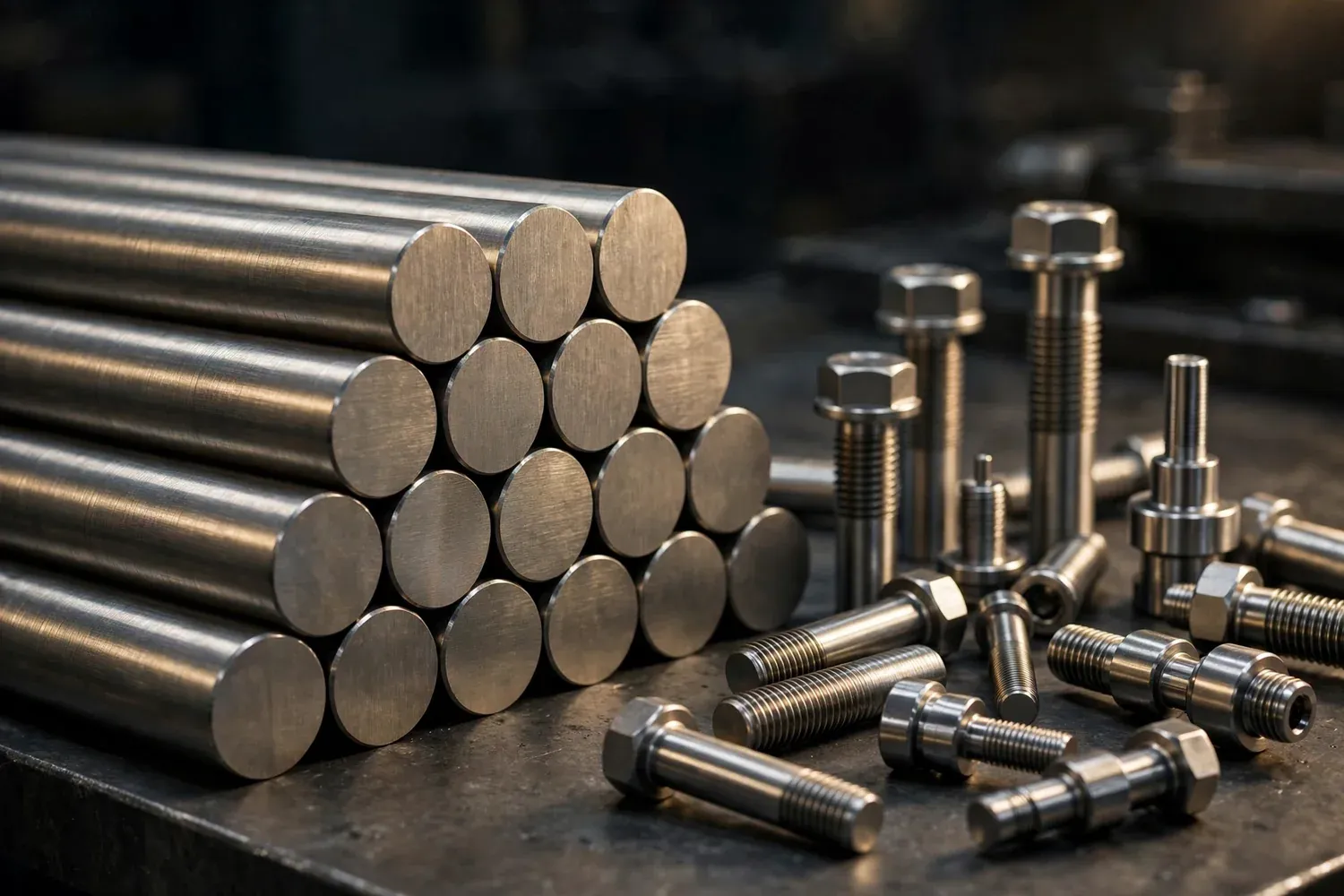
When a valve stem, fastener, or high-pressure fitting has no room to grow — but the load keeps rising — MP159 is one of the few corrosion-resistant alloys that still closes the gap.
MP159 (UNS R30159) is a cobalt-nickel multiphase alloy (nominally 35.7% Co, 25.5% Ni, 19% Cr, 9% Fe, 7% Mo, 3% Ti) that reaches ultra-high strength through cold work plus aging, rather than precipitation hardening alone. AMS 5842 covers MP159 bar in the solution-heat-treated and work-strengthened condition: solution treatment at 1900–1925°F (1038–1052°C) for 4–8 hours followed by water quench, then strain hardening. The fully aged condition (AMS 5843) is specified at 260 ksi minimum tensile and 250 ksi minimum yield.
Why engineers reach for MP159
Most high-strength corrosion-resistant alloys force a trade: strength or ductility, temperature or seawater resistance. MP159’s multiphase structure is the workaround. Cold work raises strength dramatically (annealed material sits near 123 ksi tensile), and a subsequent age at 1200–1250°F locks in yield strength above 250 ksi while keeping 6% minimum elongation (typically 8%+) and useful fracture toughness. That combination is rare at this strength level, and it is why MP159 shows up in fasteners and stems where a brittle failure is not an option.
Strength that survives temperature
MP159 holds useful strength to about 1100°F (593°C). Its closest cousin, MP35N, is generally limited to about 800°F in high-strength service — so a part that runs hot and loaded is often where the MP159 conversation starts.
Corrosion resistance at full strength
With 19% chromium and 7% molybdenum, MP159 resists crevice corrosion, stress-corrosion cracking, and hydrogen embrittlement in seawater, sour (H₂S), and salt-spray environments — in the cold-worked condition, not just annealed.
AMS 5841 / 5842 / 5843 are not interchangeable
| Spec | Condition | What you get | Hardness |
|---|---|---|---|
| AMS 5841 | Solution heat treated | Soft, machinable starting stock | 20 HRC max |
| AMS 5842 | Solution + work strengthened | High strength, ready for finishing | 38 HRC min |
| AMS 5843 | Solution + work strengthened + aged | Peak properties: 260 ksi TS / 250 ksi YS min | 44 HRC min |
Chemistry limits per AMS 5842 (wt%): Cr 18.0–20.0, Co 34.0–38.0, Mo 6.0–8.0, Ti 2.50–3.25, Fe 8.0–10.0, Nb 0.25–0.75, Al 0.10–0.30, C 0.04 max, Ni remainder. Melt practice is vacuum induction melting followed by vacuum arc remelting (VIM + VAR). Density 8.33 g/cm³.
MP159 vs. the usual alternatives
| Alloy | Tensile (ksi) | Strengths | Watch-outs |
|---|---|---|---|
| MP159 | 265–275 | Highest strength + temp to 1100°F | Cost, lead time, machining |
| Inconel 718 | 180–200 | Available, weldable, well understood | Gives up ~70 ksi to MP159 |
| Inconel 625 | 120–140 | Outstanding corrosion resistance | Not a high-strength stem alloy |
| MP35N | 260–300 | Superb corrosion + toughness | Strength fades above ~800°F |
| 17-4 PH | 180–200 | Cheap, easy to source | Corrosion limits in chloride / sour |
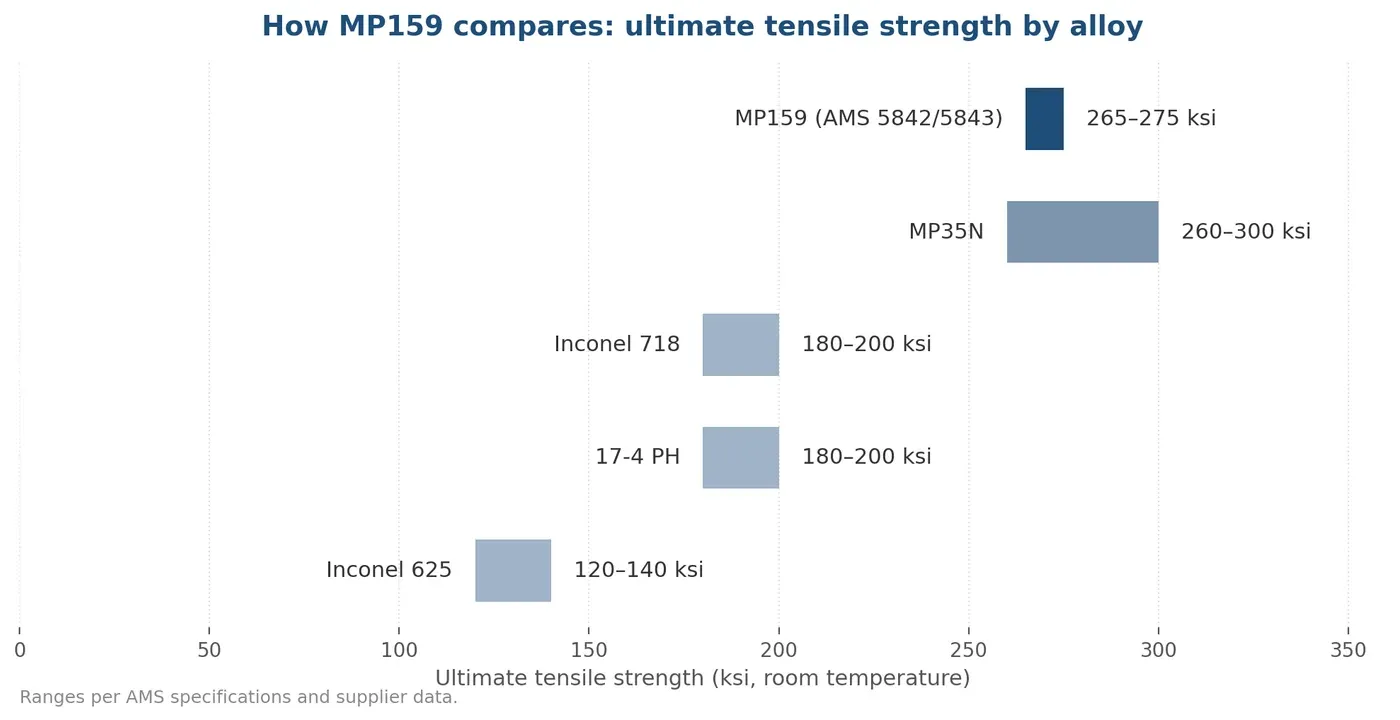
Rule of thumb: if the part fits in 718, keep 718. Specify MP159 when section size is fixed, temperature exceeds ~800°F, or fatigue life at very high mean stress is the binding constraint.
Where MP159 earns its cost
MP159 earns its place in small, highly loaded parts where upsizing is impossible and failure is expensive:
- High-pressure valve stems and trim — cone-and-thread and sour-service valves where stem diameter is capped by the pressure envelope.
- Aerospace fasteners, bolts, and studs — jet engines, rocket boosters, landing-gear hardware to 1100°F.
- Downhole and wellhead components — packers, completion tools, and sour-gas hardware (verify NACE MR0175 limits per part).
- Marine, subsea, and medical hardware — connectors, shafts, and prosthetic devices at high preload.
DFM and sourcing reality
Machine it like a cobalt alloy, not like 718. MP159 work-hardens aggressively. Rigid setups, sharp positive-rake carbide, controlled surface footage, and no dwelling in the cut matter more than exotic tooling. Finish grinding and thread rolling are commonly planned after heat treatment rather than fighting distortion later.
Specify the condition, not just “MP159.” “MP159” alone is not a purchasable condition. Call out AMS 5842 (work strengthened) or AMS 5843 (work strengthened + aged), the diameter tolerance, and whether properties must be certified at room temperature, elevated temperature, or both. AMS 5842 room-temperature minimums in aged test condition are 260 ksi tensile / 250 ksi yield with 6% elongation; elevated-temperature minimums are 205 ksi / 190 ksi.
Plan around stock and lead time. MP159 bar is stocked in a limited range of centerless-ground diameters. Larger or non-standard diameters are mill lead-time items. Lock the material PO at design freeze — in most programs, material lead time, not machining, is the schedule risk.
RFQ checklist — MP159 parts
- Drawing with AMS condition (5842 vs 5843) and hardness callout
- Bar diameter + tolerance, and whether centerless-ground stock is acceptable
- Required certs: chemistry, mechanicals (RT / elevated temp), grain size, NDT
- Service environment (sour / seawater / temperature) and any NACE requirement
- Threads, surface finish, and passivation or coating after machining
- Quantity, prototype vs production, and material-PO timing
Quoting MP159 parts? Start with our hydraulic manifold RFQ checklist for general RFQ discipline — the list above is what changes when the material is MP159. Send your drawing to Oakmet and we’ll line up material and process before quoting lead time.
Sources: AMS 5842 (SAE International); Aircraft Materials MP159 data sheet; supplier data (Lork Alloy, ZYTC, Extreme Bolt). Verify against the current AMS 5842 revision and mill certs before design release.